
AI Visibility: Get Your Business Found by AI Platform
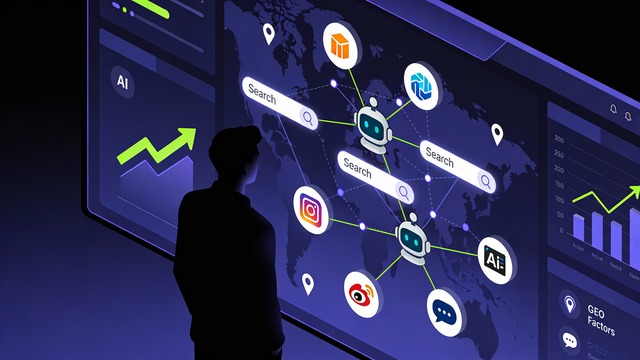
One of the biggest challenges brands will face in SEO heading into 2026 is a fundamental shift in user search behavior. Users no longer stop at a list of blue links on Google. Increasingly, their questions are answered directly by AI systems such as ChatGPT, Gemini, Claude, and Perplexity.
Search behavior is moving from active exploration toward AI-synthesized final answers.
This shift changes how brands are discovered, evaluated, and recommended online. Instead of competing for rankings, brands now compete for inclusion inside AI-generated answers.
This article is based on direct research and hands-on experience addressing that challenge. It explains what AI Visibility is, how brands can be mentioned or cited by AI systems, how AI Visibility can be measured, and how it can be improved sustainably despite the non-deterministic nature of large language models.
What Is AI Visibility?
AI Visibility is the frequency and prominence with which a brand appears in AI-generated answers when users ask questions on platforms such as ChatGPT, Gemini, and Claude.
AI Visibility reflects whether a brand is selected, referenced, or recommended by an AI system based on its semantic authority and contextual presence across the web.
This differs fundamentally from traditional SEO.
Traditional SEO focuses on page rankings within link-based search results. AI Visibility focuses on whether a brand is chosen by large language models as part of a direct, synthesized answer.
This distinction matters because AI-powered search no longer presents options. It presents conclusions.
When users ask for recommendations, strategies, or solutions, AI systems select sources they consider the most authoritative, relevant, and trustworthy. Brands without strong AI Visibility disappear from the conversation, even if their traditional SEO performance remains strong.
Is AI Visibility Important for SEO Strategy in 2026?
AI Visibility is highly relevant and increasingly practical as part of modern SEO strategy.
User behavior is steadily shifting from browsing search results to consuming AI-generated answers. The only way for brands to be recommended or cited by AI platforms is through a more comprehensive, entity-focused SEO approach.
Several factors support this shift.
Organic Traffic Is Declining as AI Search Grows
Studies from Semrush and Ahrefs show that when AI Overviews appear, organic click-through rates can drop by 30 to 47 percent. Users often feel satisfied with the AI answer and never click traditional results.
Multiple forecasts suggest that traffic from AI-driven search may surpass traditional organic traffic around 2028 if AI-based interfaces become the default.
The Rise of Zero-Click and the “Crocodile Mouth” Effect
AI answer boxes create more zero-click searches. In some cases, CTR drops from 15 percent to 8 percent when AI Overviews appear.
This creates what local SEO practitioners describe as the “crocodile mouth” effect. Impressions and rankings remain visible, but traffic shrinks because information is already summarized at the AI layer.
AI Search Traffic Converts Better
Several studies indicate that visitors arriving from AI citations tend to have stronger intent. A 2025 Forbes report stated that traffic originating from LLM-based platforms can convert up to nine times better than traditional organic traffic.
AI Traffic Is Still Limited
Despite its growth, traffic from AI platforms remains relatively small compared to traditional search. Many AI interactions end without clicks.
At the same time, optimizing AI Visibility requires research, prompt experimentation, high-quality content production, and cross-channel distribution. These efforts are not inexpensive and should be approached strategically.
Tooling Limitations for the Indonesian Market
Most AI Visibility tools are built for European and US markets. They are not yet optimized for Indonesian geo-contexts.
This limitation affects measurement accuracy and influences how likely a brand is to be cited by AI systems based on user location.
Personalization and GEO Dependency
LLM platforms generate answers based on geography, language, and regional context. The same prompt can produce different brand recommendations depending on where the user is located.
Without GEO-based testing, AI Visibility measurement becomes partially speculative and may not reflect real market conditions.
How AI Visibility Works and How It Is Measured?
AI Visibility is measured by estimating the probability that a brand appears in AI-generated answers across a defined set of prompts representing a single search context.
Measurement does not rely on one question. It relies on distribution across many prompt variations with similar intent.
AI Visibility is typically expressed as a percentage. If a brand appears in 6 out of 20 monitored prompts, its AI Visibility for that context is 30 percent.
This approach exists because LLMs are probabilistic and non-deterministic. Answers vary across executions, prompts, and time.
Most monitoring tools use around 20 prompts per topic context. Each prompt represents natural language variations that users might use. This method captures visibility opportunities more accurately than relying on a single phrasing.
Every brand appearance, whether as a mention or citation, counts as “visible.” Some tools apply additional weighting based on position, giving higher value to brands listed earlier in AI-generated recommendations.
The result is a quantitative view of how strongly a brand exists within the AI search ecosystem, allowing comparison across topics, competitors, and AI platforms.
How LLMs Recognize and Understand Brand Content ?
LLMs do not read content like humans and do not rank brands by page position.
They convert text into semantic vectors and evaluate proximity between brands, topics, and contexts. The more frequently a brand appears near a topic across many sources, the stronger that brand–topic association becomes inside the model.
LLMs think in entities and relationships, not keywords.
Brands are treated as entities with attributes such as products, segments, and locations, and relationships to categories, competitors, and topics.
As a result, research shifts from keyword ranking to entity association. The key question becomes which topics the brand is associated with in the model’s semantic memory.
Consistency matters. Brand names, descriptions, categories, and core messages must remain uniform across websites, social profiles, directories, and external publications.
LLMs build brand understanding from cumulative digital signals, not from a single high-performing page.
The Role of E-E-A-T in AI Mentions and Citations
E-E-A-T operates as a macro-level signal at the model level.
Experience
LLMs favor content demonstrating direct experience, such as case studies, proprietary data, and practical tutorials.
Expertise
Brands with consistent topical focus, clear authorship, and relevant credentials are more easily recognized as experts.
Authoritativeness
Media coverage, authoritative backlinks, and third-party citations create consensus signals that increase citation likelihood.
Trustworthiness
Consistent brand information across the web reduces ambiguity and makes AI systems more confident referencing the brand.
AI Visibility and AI Share of Voice are related but distinct.
AI Visibility measures how often and how prominently a brand appears in AI-generated answers overall. It is an absolute metric and acts as a strategic umbrella.
AI Share of Voice measures a brand’s proportion of visibility relative to competitors within the same prompt set and topic. It is a comparative KPI used for benchmarking.
Confusing the two can lead to flawed conclusions.
| Category | AI Visibility | AI Share of Voice |
|---|---|---|
| Objective | Measures how often and how prominently a brand appears in AI-generated answers | Measures a brand’s share of visibility compared to competitors within a category |
| Measurement Type | Absolute | Relative |
| Primary Focus | Brand presence, position, sentiment, and accuracy of AI representation | Portion of AI attention owned by the brand |
| Analysis Context | All AI-generated answers that mention the brand, without competitor comparison | The same set of prompts and topics applied equally to all brands |
| Calculation Method | Mention frequency, citation count, contextual quality, and sentiment | Percentage of brand appearances relative to total appearances of all brands |
| Example Metrics | AI citation count, number of visible prompts, mention context, sentiment | Percentage of AI responses that mention the brand |
| Strategic Role | Serves as the overarching strategy framework and indicator of AI representation quality | Serves as a competitive benchmarking KPI |
| Key Question Answered | Is our brand visible, and how does AI represent it? | How much of the AI conversation does our brand control? |
Challenges in Measuring AI Visibility
AI Visibility is difficult to measure because AI systems are unstable, personalized, and constantly evolving.
LLMs are non-deterministic. Identical prompts can generate different answers across time and sessions.
AI queries are continuously synthesized. Small linguistic changes can trigger different reasoning paths.
Each AI platform uses different data sources. A brand may be highly visible on one platform and invisible on another.
Models change rapidly. Strategies that work today may lose effectiveness after a model update.
This makes AI Visibility a dynamic metric that requires ongoing monitoring.
Software and Tools for AI Visibility Tracking
Below is a curated list of software and tools commonly recommended across the SEO and AI monitoring industry for tracking AI Visibility or AI Brand Visibility. These tools help monitor how brands appear, are mentioned, or cited within AI-generated answers, both across LLM platforms such as ChatGPT, Claude, and Gemini, and within AI-powered SERP features like Google AI Overviews.
-
Peec AI
A generative monitoring platform that tracks brand appearances across ChatGPT, Perplexity, Google AI Overviews, and other LLM-based systems. It includes alerts for changes in visibility and brand mentions. -
Profound
An enterprise-grade platform designed to understand, manage, and influence brand representation across AI answer engines such as ChatGPT, Google AI Mode, Gemini, Copilot, and similar systems. -
Semrush AI Visibility Toolkit
A module within the Semrush ecosystem that enables AI Visibility tracking alongside traditional SEO metrics, providing a unified view of search and AI performance. -
Otterly.ai
A monitoring tool that tracks AI-generated responses, brand mentions, and visibility across multiple AI platforms, with a user-friendly interface suitable for ongoing analysis. -
RankScale
A dedicated suite for tracking AI Visibility and semantic relevance, including metrics such as AI Share of Voice and consistent context analysis across prompts. -
Akii
An AI Search monitoring and auditing platform focused on actionable insights and brand narrative development within AI-driven search environments. -
Similarweb (AI Visibility Features)
A traditional digital intelligence platform that has expanded its capabilities to include AI Visibility monitoring and competitive benchmarking against peer brands. -
Ahrefs Brand Radar / AI Features (Roadmap)
While historically known as a traditional SEO tool, Ahrefs has begun introducing AI-related features that support brand visibility monitoring within AI-driven search contexts. -
RankPrompt Tools (Aggregated Tooling)
A combined toolkit that aggregates multiple AI Visibility trackers, including ZipTie, Otterly AI, Scrunch AI, and RankScale, into a single tooling reference. -
Writesonic (with GEO and AI Monitoring Features)
A generative AI platform that includes modules for monitoring how content is positioned within AI search results and brand mentions, alongside content creation capabilities.
What are Strategies to Improve AI Visibility ?
AI Visibility optimization focuses on how a brand is understood, trusted, and selected by AI systems.
Key strategic pillars include:
-
Building a clear and consistent brand entity
-
Prioritizing topical authority through content clusters, not single hero pages
-
Writing content that is easy for AI to extract and cite
-
Demonstrating real E-E-A-T signals through experience and evidence
-
Creating consensus through PR, community, and multi-channel distribution
-
Optimizing brand mentions and relevant co-mentions
-
Providing citation-ready snippets such as definitions, statistics, and frameworks
-
Monitoring performance longitudinally across platforms and prompt variations
-
Aligning AI Visibility efforts with long-term business goals, not short-term mentions
A Caution on Correlation vs Causation in AI Visibility Research
Brands should be cautious when interpreting AI Visibility studies found online.
Many published experiments show correlation, not causation. The fact that a brand appears in AI answers alongside certain characteristics does not mean those characteristics caused the visibility.
Examples include studies linking Domain Rating or backlinks directly to LLM citations without accurately reflecting how LLMs function.
Misinterpreting these findings can lead to ineffective or misleading optimization decisions.
AI Visibility and Doxadigital
AI Visibility is not a temporary trend. It represents a structural change in how brands are discovered and represented in the AI era.
When AI answers replace link lists, brands no longer compete for position. They compete for trust, consensus, and semantic relevance inside LLM systems.
AI Visibility is shaped by interconnected factors such as entity strength, E-E-A-T quality, narrative consistency, and citation patterns. Measurement is complex due to model non-determinism, platform differences, geo-dependency, and correlation bias.
Because of this complexity, AI Visibility cannot be optimized through short-term tactics. Brands that succeed build long-term foundations based on topical authority, clear positioning, and consistent narrative distribution.
DoxaDigital helps businesses build AI Visibility strategically and sustainably, not by chasing short-term mentions but by strengthening semantic authority and trust within AI systems.
If your brand needs to remain visible and relevant in the age of AI-driven search, now is the time to build that foundation.

Viktor Iwan adalah CEO dan pendiri Doxadigital Creative Digital Agency. Dia juga merupakan pembicara dan pelatih publik dalam berbagai acara pemasaran digital seperti “Social Media Week”, “Tech in Asia”, “WordCamp”, “SEOCon”, “QuBisa Bootcamp”, dan “Google Agency Bootcamp”. Viktor Iwan memiliki sertifikasi Google Ads, Facebook Lead Trainer, Facebook Media Buying and Planning, dan Google Analytics. Dia juga menjadi salah satu dari 5 Product Expert Google Ads asal Indonesia oleh Google Inc.
Viktor Iwan juga memiliki website pribadi di viktoriwan.com.
Latest Articles


